.Back to Articles Index   Site Map

Tidd Tech, Ltd.

Tidd Tech, The Finest Snow Grooming Equipment for Cross Country Skiing

ARTICLES - 1999


Maintaining Your Machine

How to Get the Most Out of Your Trail Tenderizer

Here are a few tips that should help you tame that hardpack this year:

 First, make sure your teeth are in good shape. 

Tooth Bar Sharpening Diagram

Sharpening your tooth bar is recommended when the points become rounded. Use a 4” angle grinder and grind the shaded area while maintaining a 45-degree bevel. Work the grinder parallel to the face of the tooth so as to restore the sharp point. This will leave an additional point above the grind, which will cut snow, too.

Tooth Bar

Check the top of the raise/lower crank jack for two washers. One is bronze and the other is steel. They are right under the handle and on top of the jack housing. If they are there, grease them a bit. If they’ve worn off, call us and order some new ones.

Check you skid plates at the back corners of the compactor. They should not be worn down into the square holes. They are designed to be rotated so that each of the four corners wears down, and then the plate should be replaced.

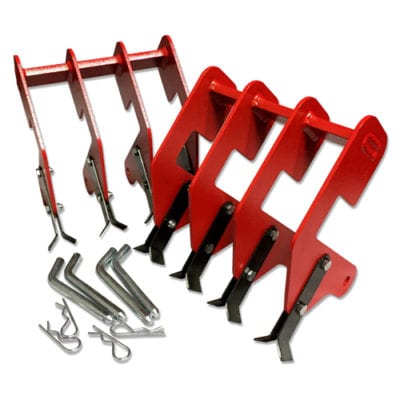
On some Tracksetters with white HDPE bases, the links (red H shaped brackets that attach the Tracksetter to the compactor) tend to hit the Tracksetter base when they flex up and down. If this is the case on your Tracksetter, cut away a small square of the plastic base under the link with a hacksaw to provide clearance.

Occasionally, customers ask us about adding weight to their Trail Tenderizer to make it more effective in tough renovating conditions. If you have taken care of the previous maintenance items, then here are our suggestions for adding weight:

If you have the newer style Tracksetter with the hinged lid, your first and best option for adding weight is to fill the Tracksetter with two solid blocks and flip it up on the bed (the Tracksetter remains pinned to the comb bar). One Tracksetter with two solid blocks weighs about 112 pounds. With good teeth and a loaded Tracksetter, you should be able to get a good “bite”.

If you don’t have the hinged lid track setter, and you wish to add weight, it is very important that you DO NOT PLACE LOOSE, HARD OBJECTS ON THE COMPACTOR BED since these will likely cause damage as the machine bounces over rough terrain. Here is a safe way to add some weight: Go to your local hardware store and buy a bag or two of “tube sand”. These are the 75 lb. long, skinny sandbags marketed as vehicle weights. Open one end, dump about half of the sand out, and reseal. Now you have a nice compliant weight that won’t damage the Tenderizer and also won’t bounce off. You can place the tube sand up toward the front of the machine on the tooth bar where it is most effective. Warning: the tube sand is sold dry, and you need to keep it that way. If you let it get soggy, it will freeze and may damage your machine.

Remember that when the grooming gets tough, you will get the job done faster and with less frustration if you make multiple passes with a less aggressive cut. If you try to cut too deeply in a single pass you risk overloading your snowmobile, and the groomer will likely bounce even at a very slow speed leaving a less than desirable product.

Back to Top

Back to Article Index   Site Map


.

Ultimate Best Line

Be a Track Setting Hero

Back in the days before skating, setting technical cross-country ski trails was an art. Good track setters not only knew when to lay the tracks and when to pull them, they also knew how to follow the “best line” around curves.

Today, most classic tracks share the trail with a wide skating lane. There are plenty folks who enjoy arguing the pros and cons of the new wide trails vs. the “good old days”. What I find interesting is that most of this discussion centers on the width of the trail and it’s feeling of “intimacy”. We often forget another reason why the old trails had a different “feel”.

In the old days if you were setting track on an 8’ logging road, for example, you got to “define the curve”. You would start at the outside of an approaching corner, cut across to the inside and finally end on the outside again – we know this as “taking the best line”.

Today, as we set our tracks on one side of the skating lane, we are completely at the mercy of the trail itself. Curves are defined now by the trail cutter, not the track setter.

Next time you set tracks for that “classic only” race course, or if you would just like to try something fun on a section of trail, try setting a best line course. But before you fire up the snowmobile, do some research and training:

First go ski the section of trail. My recommendation is to ski it on skating skis, taking the curves and corners as aggressively as you can. Pay attention to the line you take through the curves. If you don’t feel proficient, park yourself at the edge of the trail and watch a good skier’s line. Take lots of notes with sketches, because it will all look very different through the windshield of the snowmobile.

Now go set some tracks. Follow the line you picked while on skis, even if it doesn’t look right from the snowmobile. Ski the tracks and feel the difference. It is amazing how much more fun it is to ski a best line track. Were you a little overzealous on some of the down hill corners? It is very important when setting best line to “pull” the tracks when the curve becomes too fast.

More so than ever, skiers must trust a best line track setter’s judgment – if the tracks are there, they will use them, often because they don’t have a choice (the tracks cut across their path). And when they do successfully ski through that downhill curve in a tuck you will be their track-setting hero. But if you set tracks around a corner that is too tight for the average skier, you are the goat, so learn your trade well.

If you have the option of using a snowmobile track setter in combination with snow cat equipment on a wide trail, here is an idea for the ultimate best line course: Send the snow cat (with the tiller running if you have one) out just ahead of the snowmobile/tracksetter. Run the snow cat slow enough that your snowmobile track setter can follow right behind, so that you are setting tracks before the tilled snow has a chance to set up. Set your best line with the snowmobile, using the full width of the trail through the curves. You will end up with a wonderful product that not only looks great but will stand up to some pretty hard use. If you are grooming exclusively with a snowmobile, make enough initial passes to cover the full width, then follow with your best line track-setting pass.

Don’t be afraid to experiment a little with track placement. Sometimes we get in a habit of doing things a certain way and forget that it can be a thrill for skiers to experience something new and different. Another trap to avoid is the thinking that tracks and skating are incompatible. It is just as fun for the skaters to hop into a best line track down and around a curve as it is for your classic skiers. If you have a wide, one way trail over some rolling terrain that is normally groomed as a skating lane with classic track on the side, try setting the APPROPRIATE downhill sections best line (you can still leave a skating lane everywhere else). I think you will enjoy the response you get from your skiers.

Back to Top

Back to Article Index   Site Map


Pole Creek Machine Copyright © 2011, all rights reserved